
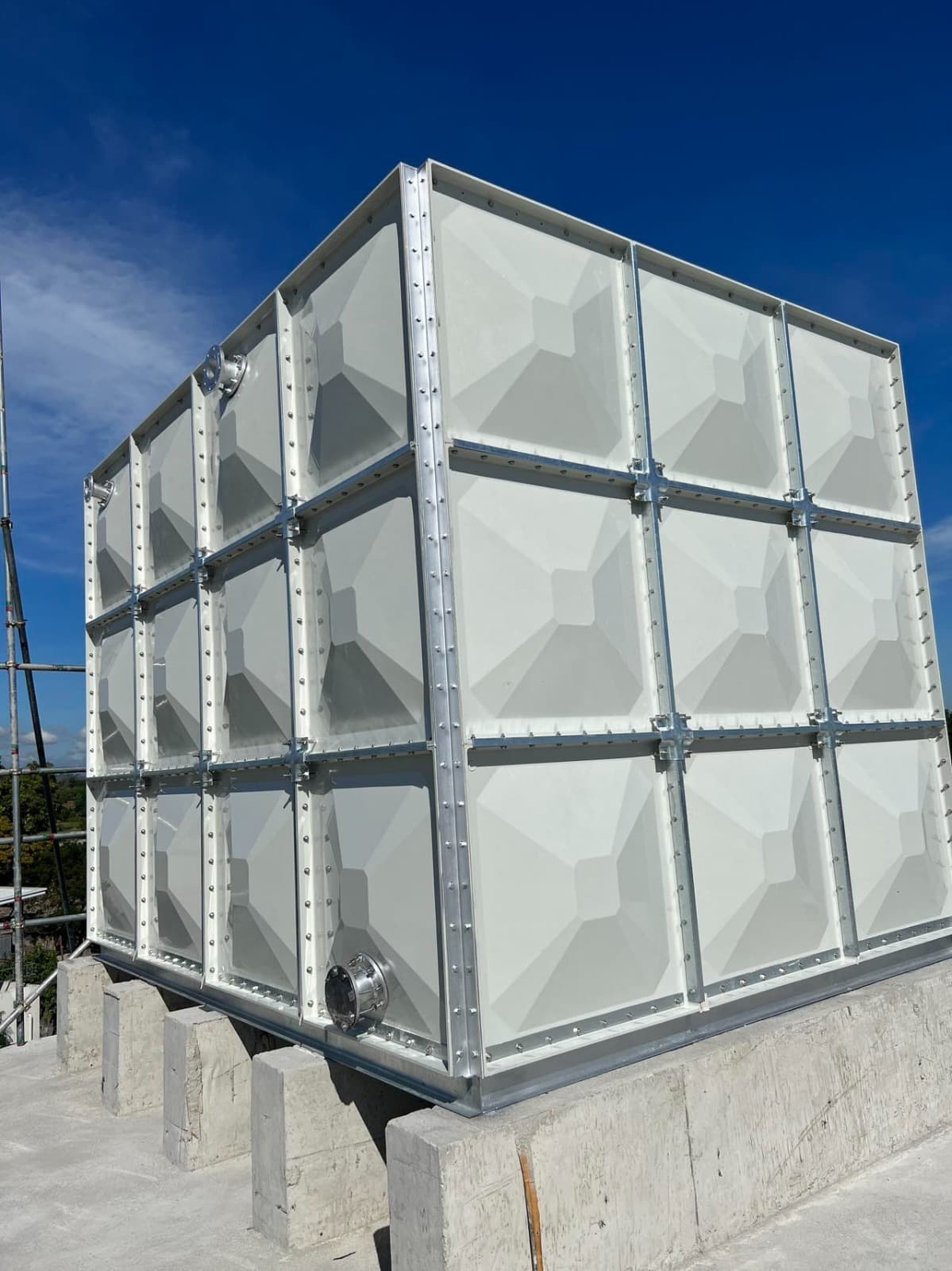
FRP Panel Water Tank Philippines: Supply, Install and Commission
5 m³ to 1,000+ m³
The industry standard for commercial water storage in the Philippines. Corrosion-proof, food-safe, modular, and assembled on-site to any capacity from 5 to 1,000+ m³.
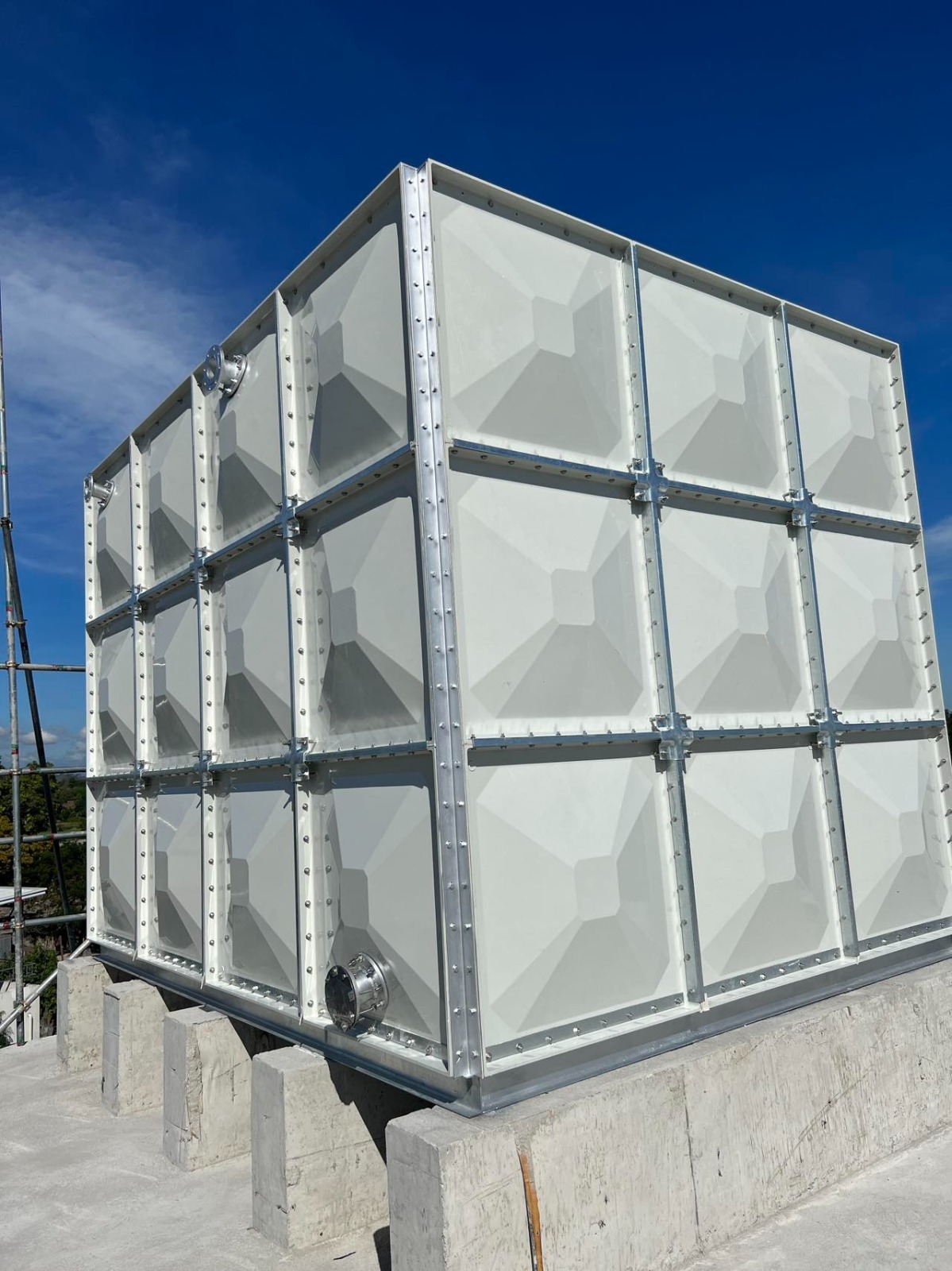
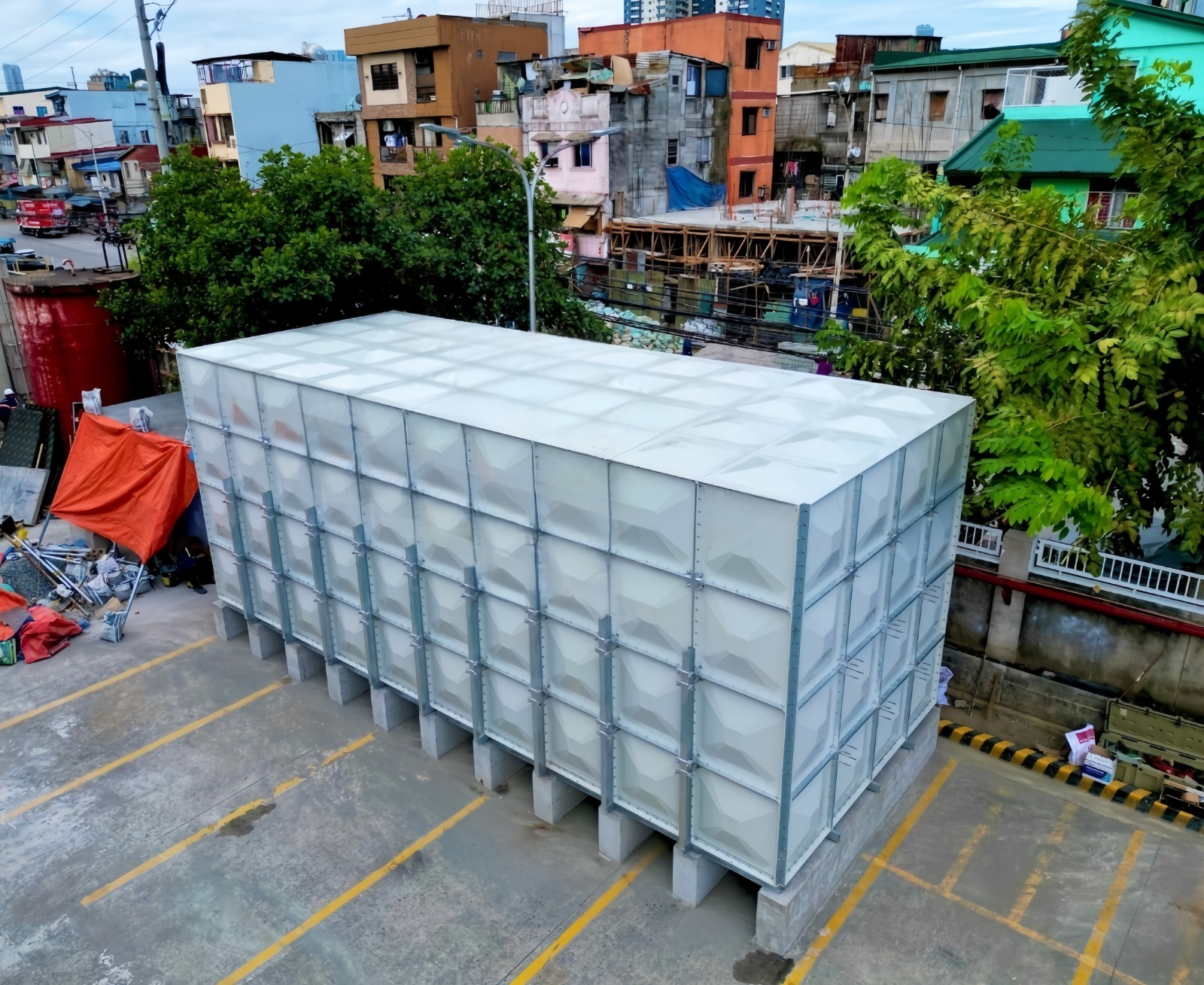
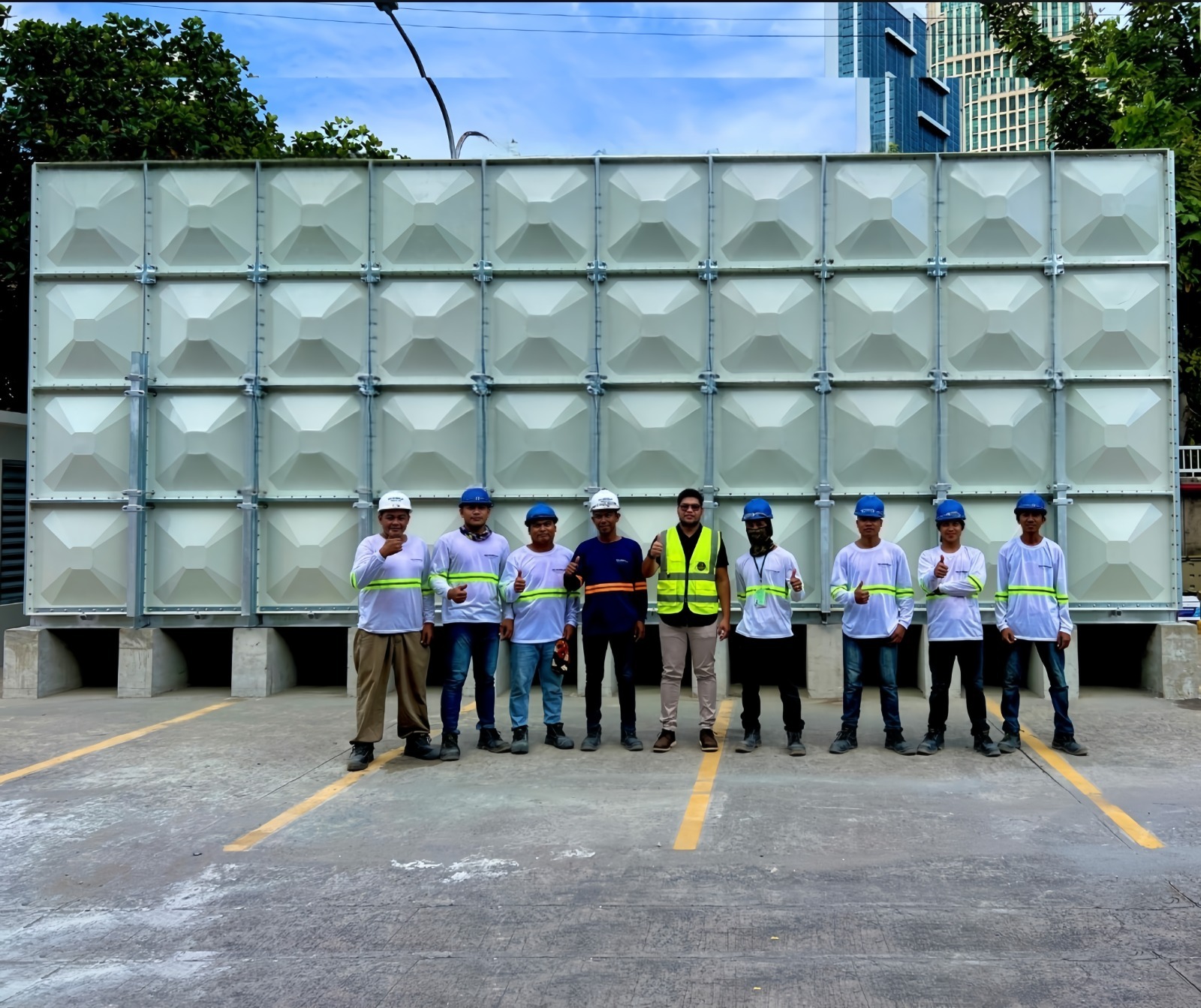
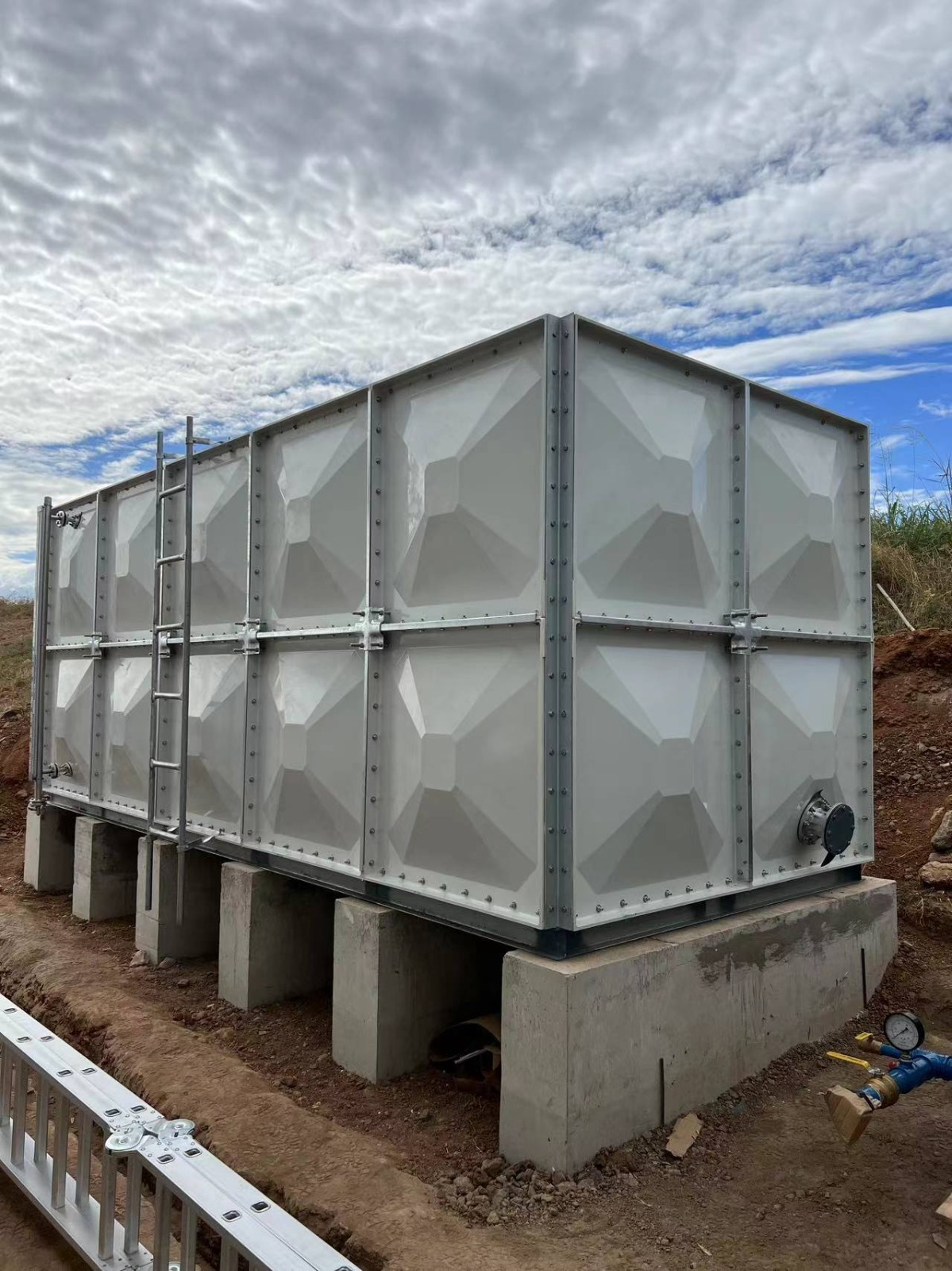
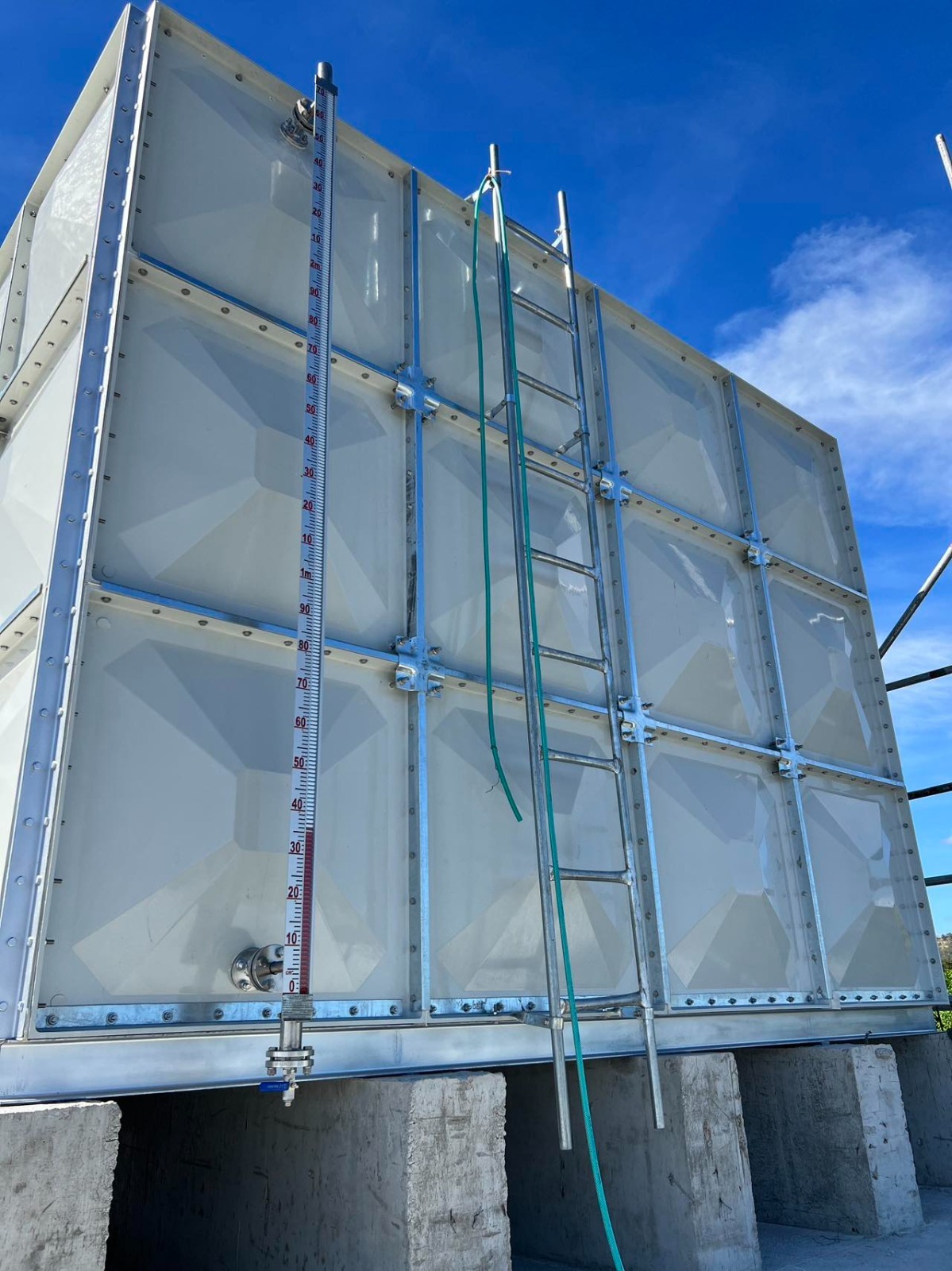
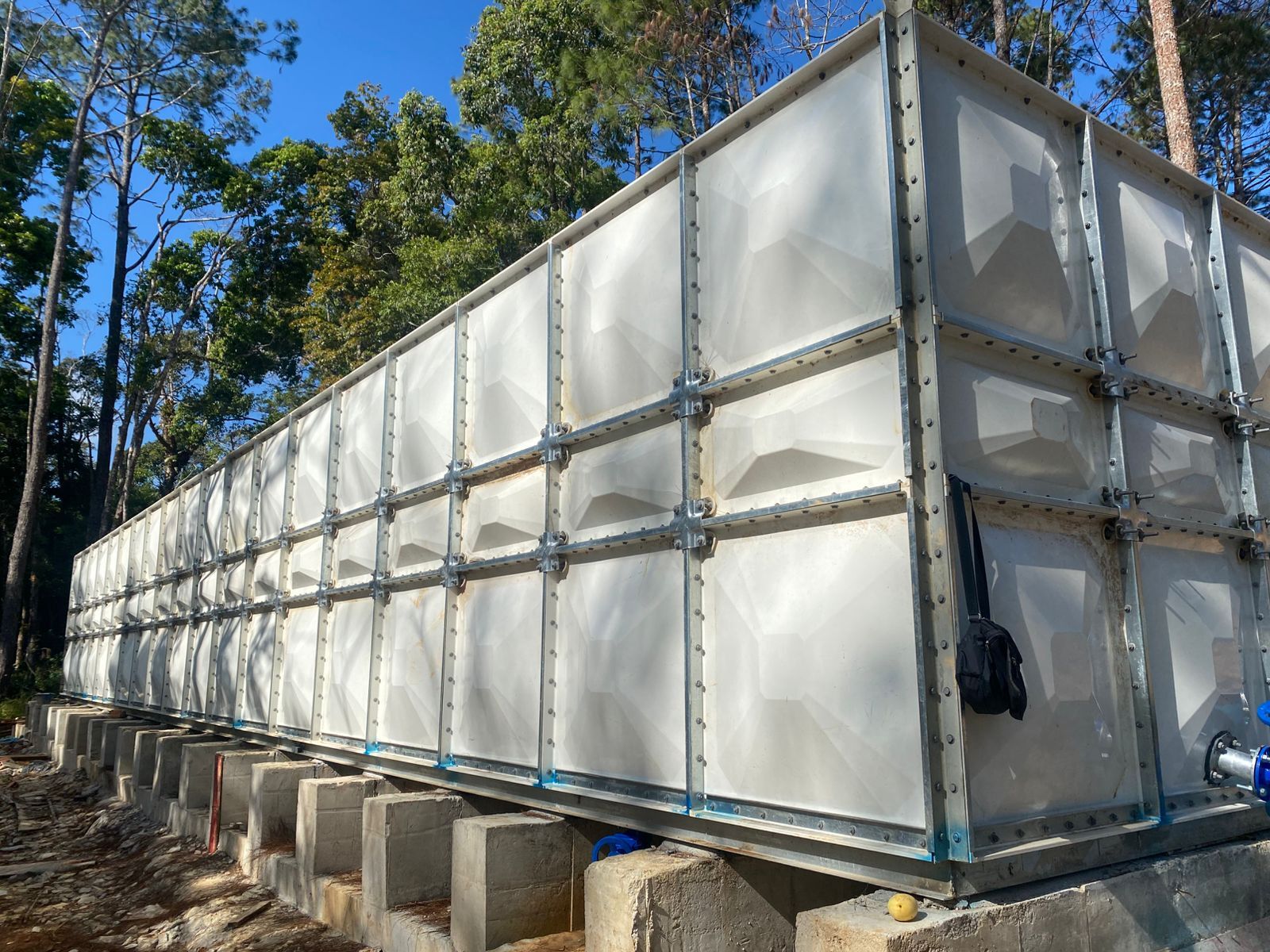
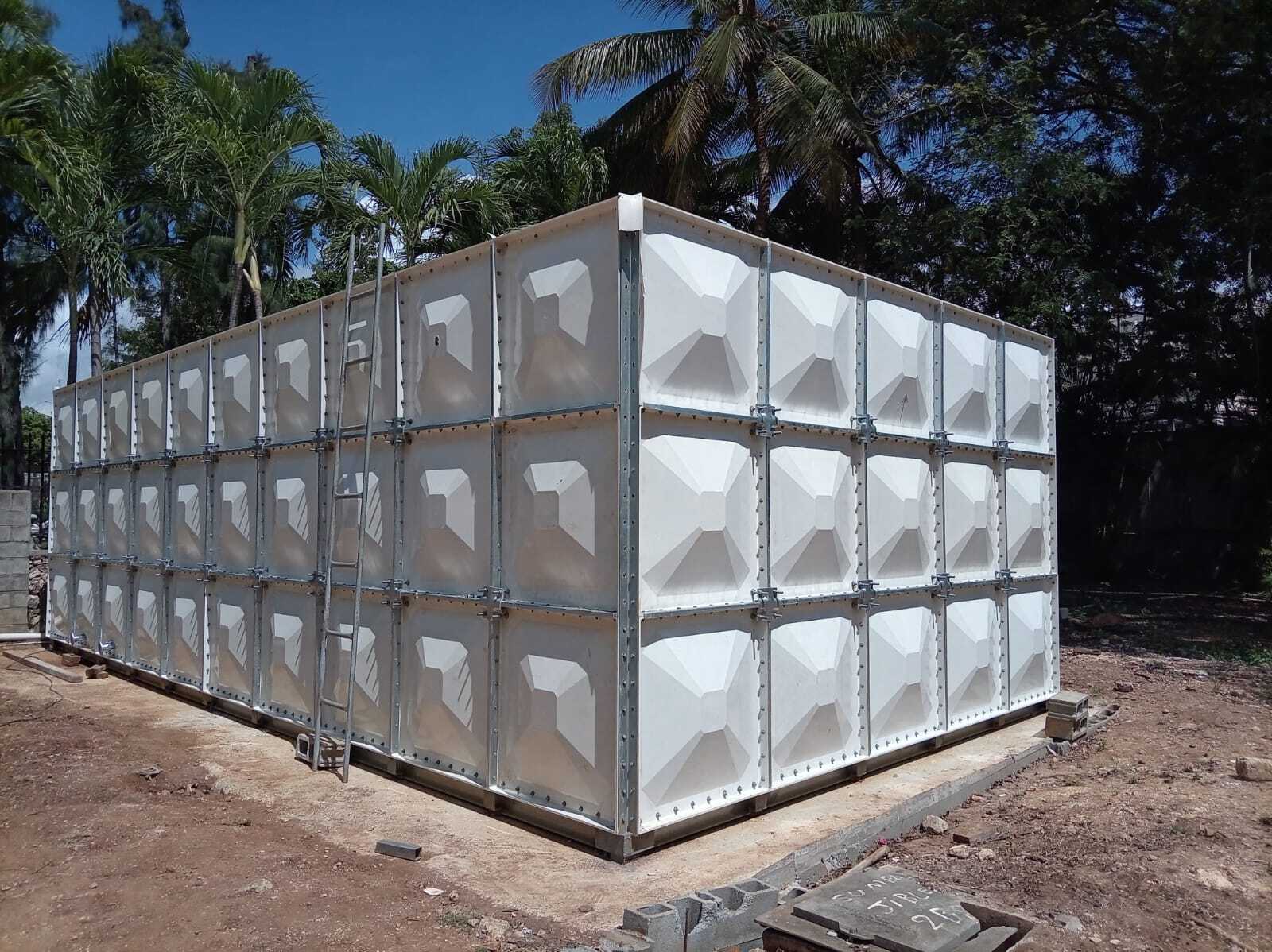
Modular fiberglass panels bolted on-site. The industry standard for drinking water, fire reserve, and industrial storage. Corrosion-proof, food-safe, and expandable. Built to WRAS certification standards with 23 years of production experience behind every panel.
All tanks WRAS-certified. Custom capacities and configurations available.
What it is, and where it fits
A GRP (glass-reinforced plastic) panel tank: also marketed as an FRP panel water tank (fiberglass-reinforced plastic) or SMC (sheet-moulding compound): is built from individual 1 m × 1 m or 1 m × 0.5 m hot-pressed fiberglass panels bolted together on the installation pad. Each panel is reinforced with E-glass fibre and isophthalic resin, food-grade certified to the supplier's local standard (FDA, WRAS, or equivalent), and rated for potable water in continuous service.
Because the tank is bolted on-site, it can be built anywhere a truck can deliver flat-packed panels: basements, mezzanines, rooftops (with structural review), tight pump rooms, and outdoor pads. Panels pass through 800 mm doorways. A 100 m³ tank fits on a single 6-wheeler delivery truck before assembly.
If you are choosing between GRP/FRP and concrete, GRP wins on speed (days vs months), repairability (swap one panel vs jackhammer the wall), and corrosion (zero, vs progressive over 10–15 years in tropical climate). If you are choosing between GRP/FRP and a one-piece plastic tank (HDPE roto-mould), GRP wins above ~10 m³ and is the only option above ~25 m³.
FRP panel water tank supply across the Philippines: capacity and certification
TankSmith supplies and installs FRP panel water tank systems nationwide across the Philippines, from NCR and the rest of Luzon through Visayas and Mindanao, including locators inside PEZA zones, SBMA, Clark, and the Cavite and Batangas industrial estates. Systems run from 1,000 liters to 500,000 liters per tank system. Because an FRP panel water tank is assembled from bolted panels on a modular grid, capacity is set by the length, width and height you specify rather than by picking the nearest size from a fixed catalogue: a tall narrow tank suits a rooftop with limited floor area, and a low wide tank suits a slab with a strict load limit.
For potable duty the certification question comes first. Panels are WRAS-certified for potable water contact, liners are NSF-compliant, and panels are produced under an ISO 9001 quality management system at partner factories with TUV SUD test documentation available for the panel series. We do not manufacture the panels ourselves: we specify them, source them from ISO 9001 certified factories, and stand behind the installed system. Ask any supplier for the actual certificate covering the panel grade being quoted, not a generic badge, especially when compiling a submittal package for a hospital, a food plant or a PEZA locator in the Philippines.
Every FRP panel water tank quotation is scoped as supply, install and commission under one contract, and the same team sizes the booster pump set that feeds the building from the tank. Most buildings that ask about a tank are actually describing a pressure problem, so the storage side and the pressure side are engineered together: vertical multistage CDL and CDLF pumps from 0.37 kW to 200 kW in SS304, controlled by IP54 VFD duplex panels with pressure feedback and automatic alternation. The handover figure is delivered pressure at the furthest fixture, not just a tank in the Philippines that holds water.
Specifications
| Panel material | Hot-pressed GRP / SMC, E-glass + isophthalic resin |
| Panel thickness | 3–8 mm (varies by tank height) |
| Standard panel sizes | 1000 × 1000 mm and 1000 × 500 mm |
| Tank height (single tier) | Up to 3 m; multi-tier up to 4 m |
| Capacity range | 5 m³ to 1,000+ m³ (any rectangular footprint) |
| Internal lining | Food-grade gelcoat, NSF / WRAS / FDA-equivalent certified |
| Fittings | SS304 bolts standard; SS316 optional for coastal sites |
| External finish | UV-stabilized for outdoor exposure |
| Service life | 20–25 years in PH tropical conditions |
| Pressure rating | Atmospheric (vented); not for pressurized storage |
| Temperature | Continuous service to 50 °C; short-term excursions to 70 °C |
Standard panel sizes and tank dimensions
| Capacity | Footprint (L × W × H) | Common application |
|---|---|---|
| 10 m³ | 2 × 2 × 2.5 m | Small commercial backup |
| 25 m³ | 5 × 2 × 2.5 m | Restaurant chain, small clinic |
| 50 m³ | 5 × 4 × 2.5 m | Mid-rise residential, school dorm |
| 100 m³ | 8 × 4 × 3 m | Warehouse fire reserve, hotel |
| 200 m³ | 10 × 7 × 3 m | Factory process water |
| 500 m³ | 14 × 12 × 3 m | Large industrial / institutional |
Where it's installed
- Warehouse fire reserves: 100–300 m³ tanks paired with NFPA-compliant fire pumps
- Condominium and hotel potable storage: 50–250 m³ with pressure booster systems
- Factory process water: non-aggressive process media, cooling tower make-up
- School and dormitory potable: 30–100 m³ for campus distribution
- Government buildings: LGU offices, barangay halls, evacuation centres
- Healthcare (non-clean-utility): hospital fire reserves, laundry, HVAC make-up
How it's installed
- 01.Pad preparation: we verify the existing concrete pad's load rating; if needed, we design and pour a new pad to match the filled tank weight (~1 t per m³).
- 02.Panel delivery: flat-packed; one 6-wheeler per 100 m³ approximately.
- 03.Base assembly: bottom panels are sealed with food-grade EPDM gaskets and torqued in sequence.
- 04.Wall assembly: panels stack and bolt upward, level checked every course.
- 05.Top cover and access: manhole, vent, overflow, drain, and inlet/outlet flanges installed.
- 06.Internal sealing: joints sealed with food-grade gel; pressure / leak test for 24 hours.
- 07.Disinfection: chlorination per WHO drinking-water guidance, then drain and rinse.
- 08.Commissioning: handover documents signed: pressure-test record, leak-test record, disinfection certificate, panel-replacement guide.
Typical timeline: 5–8 days for 100 m³, 10–14 days for 200 m³+.
Pricing: what drives the cost
We will not quote a price-per-litre on a webpage; every project is sized to the footprint, height, fittings, and access. But the cost drivers are predictable:
- 01.Capacity: biggest factor; larger footprints move the per-m³ rate for standard tanks under 200 m³.
- 02.Panel grade: heavier panels for taller tanks add 10–20%.
- 03.Fittings spec: SS316 vs SS304 bolts, flanged vs threaded inlets, manhole count.
- 04.Site access: basement installations and high-floor pump rooms with no service lift add labour.
- 05.Pad and structural work: if a new pad or beam reinforcement is needed.
- 06.Distance from Metro Manila / Cebu hubs: Visayas/Mindanao adds 5–12% logistics, quoted upfront.
- 07.Pump system pairing: if quoted as a bundle with a pressure booster pump system.
Common questions
Is GRP/FRP safe for drinking water?
Yes. Panels are gelcoat-lined with food-grade resin certified to NSF / WRAS / FDA-equivalent standards. After installation, we chlorinate the tank to WHO drinking-water guidance and provide the disinfection certificate.
How does GRP compare to concrete?
GRP wins on speed (days vs months), repairability (swap a single panel vs demolish a wall), corrosion (none vs progressive in PH humidity), and weight (~1/10th the dead load on the pad). Concrete is cheaper only at very large volumes where you also need ground-level construction and have no time pressure: and even then, lifetime cost favours GRP.
Can a GRP tank be installed indoors?
Yes. Panels are 1 m × 1 m maximum and pass through standard doorways. We install in basements, mezzanines, and pump rooms routinely. Ceiling clearance must equal tank height plus 0.5 m for assembly.
What is the lead time?
Standard panel sizes are stocked in PH; lead time from PO to delivery is 2–3 weeks, plus 1 week installation for a 100 m³ tank. Custom dimensions or large tanks (300 m³+) add 1–2 weeks.
Do you supply the pump and piping too?
Yes. We quote tank, pump, panel, and installation as one bundle so the system is sized, supplied, installed, and commissioned by one team.
Do you install an FRP panel water tank outside Metro Manila?
Yes. Coverage is nationwide across the Philippines: NCR and the rest of Luzon, Visayas and Mindanao, including locators inside PEZA zones, SBMA, Clark, and the Cavite and Batangas industrial estates. Include the site location in your brief so mobilisation can be planned around gate passes and locator requirements, which affect the schedule more than the panel assembly itself does.
Pair it with
An FRP panel water tank stores water; a pressure booster pump system distributes it. We size both together so the pump's NPSH-available matches the tank's suction head, and the building gets the pressure it actually needs: not the pressure on a generic catalogue spec sheet.
HDG Steel Panel Tank
20 m³ to 5,000+ m³
Heavy-duty galvanized steel panels for large-volume industrial, fire reserve, and underground storage.
View SpecsStainless Steel Tank
5 m³ to 500+ m³
SS304 or SS316 modular panels for food processing, hospitals, and high-hygiene applications.
View SpecsReplacement Panels
Individual panels: all tank types
Original panels for tank repair, capacity expansion, or color-coding existing installations.
View SpecsFound this useful? Add TankSmith as a Preferred Source on Google so our tank sizing guides show up first next time you search.